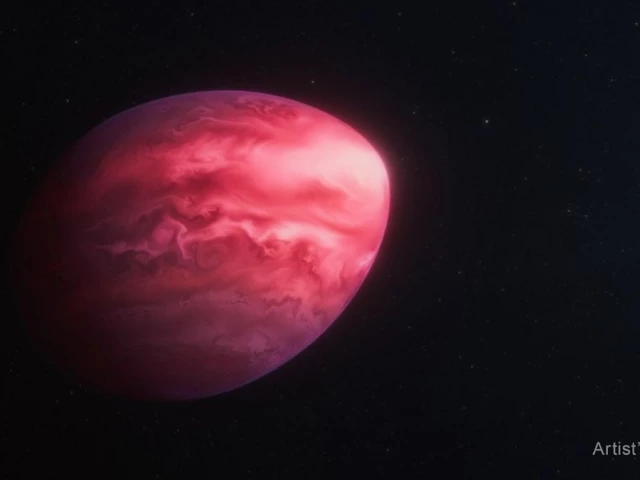

An Incredible Discovery: The Lemon-Shaped Exoplanet PSR J2322-2650b
Have you ever imagined a planet shaped like a lemon? Well, astronomers have recently stumbled upon this fascinating sight in the cosmos! Meet PSR J2322-2650b, an exoplanet orbiting a pulsar, which is a type of dense, rapidly spinning dead star. What’s even more intriguing is the planet’s unique atmosphere, rich in molecular carbon but completely devoid of nitrogen and oxygen. This challenges everything we thought we knew about how planets form.
Using the state-of-the-art James Webb Space Telescope, scientists have made groundbreaking observations. Michael Zhang, a postdoctoral researcher from the University of Chicago, mentioned that this odd atmospheric composition is unprecedented. Typically, where there’s carbon in the universe, nitrogen and oxygen follow. Yet here, it’s just carbon, in a lemon-shaped gas giant that has been stretched by the intense gravitational forces of its pulsar host. While gas giants around typical stars show minor distortions, the dramatic deformation of PSR J2322-2650b is a whole new ballgame.
What makes this discovery even more captivating is the possibility that this carbon might extend all the way to the planet’s core—possibly even in the form of diamonds! Just imagine a diamond-rich core, gleaming under the cosmic rays of its pulsar.
Now, when it comes to how PSR J2322-2650b came to be, researchers are scratching their heads. Conventional theories simply don’t fit the bill here. Some speculate that it might be the remnant of a stripped star, yet that still doesn’t explain the missing nitrogen and oxygen. Zhang remains optimistic, suggesting that this could be an entirely new category of planetary objects, which opens up exciting avenues for future research in planetary science.
In a universe full of mysteries, discoveries like PSR J2322-2650b remind us that there’s so much we have yet to learn. If you’re eager to dive deeper into fascinating scientific discoveries and stay updated on the latest astronomical findings, connecting with resources like Pro21st could be a great step forward. Together, we can explore the wonders of the universe!