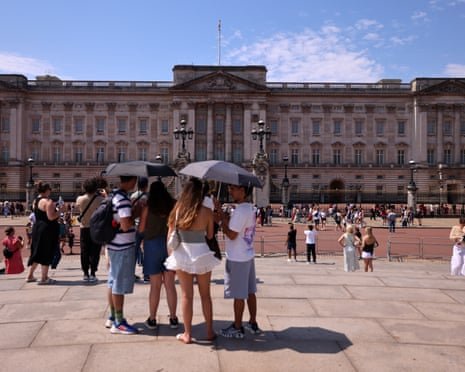

UK June heat record pushed even further to 37.3C
A provisional temperature of 37.3C has been reached in Santon Downham, in Suffolk, setting another record UK high for June, the Met Office said., as rare red warnings remain in place on Friday
This beats the previously reported 37.1C from earlier today, which was provisionally set in Cavendish, Suffolk this afternoon.
These smashed the longstanding record for June heat – which dates back to the summer of 1976 – by more than 1C, which is significant given such records were usually broken only by a fraction of a degree in the past.
Forecasters expect temperatures to reach as high as 36C in London and 35C in Manchester on Friday. Belfast and Cardiff are forecasted possible highs of 26C.

“This exceptional spell of hot and humid weather will maintain its grip on the UK for a little longer,” said one of the Met Office’s chief meteorologists Andy Page.
“Although the current red warning for areas in more central and western parts of England and Wales will expire later today, the heatwave will still be bringing high temperatures to these areas, albeit moving away from the peak heat of Wednesday and Thursday.
“We are expecting that some daytime maximum temperatures could exceed 36C, perhaps rising to 37C in some locations.”
Prof Stephen Belcher CBE, Met Office chief scientist, said: “The heatwave this week is a significant weather event, with a Red Extreme Heat warning issued. Human induced climate change has made events like this more likely and more intense.
“To see temperatures like this in the UK in June is sobering. Events like this bring home the implications of climate change, with very high temperatures and humidity bringing significant health implications from heat stress, as well as impacts to a range of sectors such as transport, energy and water supply.”
Key events
Women and low-income families bear brunt of heatwave
Report by Elodie Clements:
The heatwave afflicting western Europe is the worst ever, with the combination of heat and humidity fuelled by the climate crisis making scores of cities feel unliveable. While for some the adverse impacts amount to disturbed sleep and sticky days in the home office, low-income families are often worse affected by cities’ lack of adequate adaptation measures, with women at the sharp end.
“[It] throws a grenade into every vulnerability you already have,” says Asad Rehman, chief executive of Friends of the Earth, pointing out that vulnerable or marginalised groups often bear the brunt of climate crisis-based hardship globally.
In built-up cities, the socioeconomic aspect of this disparity can be most acute: studies have found that trees can halve the urban heat island effect but green spaces are not distributed equally, meaning poorer communities in densely packed flats and houses tend to suffer most. Rehman cites a study that found tree shade reduced maximum surface temperatures by 19C, while grass reduced them by 24C.
For Emily Dickinson, 36, her partner, Danny Swain, 34, and their son, Oliver, 10, a small living space aggravates the impact. Their one-bedroom apartment in Tufnell Park, London, made it impossible for Oliver to study after his school closed on Tuesday, along with more than 1,000 around the country. The family also have no nearby access to green spaces, having to walk in scorching heat to access cooler areas.
“It’s been unbearable,” Dickinson says. “At school, he was probably more comfortable than in our living situation.” This is exacerbated for families who face not just having to entertain a child in a hot home, but losing out on work at the same time.
“We feel like we’re the peasants that just have to deal with it,” she says. In unexpected circumstances such as this heatwave, expenses like air conditioning and fans add an impossible burden to already stretched finances. While she hopes the government will look at the inaccessibility of expensive air conditioning for low-income families, she is pessimistic about whether any effective change will be made to improve social infrastructure’s ability to cope with extreme heat.
Read the full report here:
UK June heat record pushed further to 37.1C
And the UK record for the hottest June day ever has now been broken again, with 37.1C provisionally recorded in Cavendish, Suffolk this afternoon, the Met Office said.
This surpasses the high of 36.7C recorded in Merryfield, Somerset, on Thursday – with both figures being over 1 degree Celsius higher than the longstanding June record set in 1971.
Met Office climate spokesperson Grahame Madge said: “Before this week, the 1976 UK June temperature record had stood for 50 years, but – provisionally – it has been exceeded on three consecutive days this week.
“And importantly those new records have come from a broad swathe of southern England, from Somerset to Suffolk: this shows what a widespread and impactful event this current heatwave has been.”
Adapting to the heat: four ideas from European cities

Ajit Niranjan
Europe environment correspondent
Extreme heat has seared Europe this week, alarming doctors as the UK smashed its top heat record for June three days in a row, and France sweltered through its hottest day and night on record.
But even as fossil fuel pollution bakes the planet, making heatwaves hotter and longer, some places are adapting better than others.
What have European cities done to stay safe when it gets too hot?
UK ozone noted above WHO safety levels, expert says

Damian Carrington
As if the heat wasn’t enough, the extreme temperatures in the UK has also sent levels of ozone air pollution soaring.
“Some ozone in the UK has been transported from further afield but during heatwaves, high temperatures and strong sunlight increase regional production of ozone,” says Dr James Weber, at the University of Reading.
“This week ozone breached World Health Organization safety levels at most [government] air pollution monitoring sites.”
“On Tuesday, 60 of the 97 sites measuring ozone went over the limit; 55 did so on Wednesday and 54 on Thursday, primarily in southern England. Levels are likely to stay high throughout the heatwave,” he says.
“Ozone is harmful to breathe, particularly for older people, children and those who are medically vulnerable. This can exacerbate the other health issues caused by heatwaves.”
Great Britain’s grid operator warns again over power supplies in heatwave
Jillian Ambrose
Energy correspondent
Great Britain’s energy system operator has raised the alarm over electricity supplies for the second time this week as the heatwave continues to disrupt Europe’s energy markets.
The National Energy System Operator (Neso) issued a notice late on Thursday asking generators to provide any extra electricity possible on Friday evening to help meet rising demand as households turn on air conditioners and electric fans to cope with the heat.
The operator said it was calling for extra power supplies because its forecasts showed “tight margins on the electricity system” for Friday evening due to “the impact of extremely high temperatures affecting Great Britain and the continent”.
The government-owned body added that the electricity supply was not at risk, indicating that a blackout was not imminent.
The market warning was the second this week after Neso called for backup on Tuesday night before a rise in demand on Wednesday evening when the high pressure heat dome that has led to Europe’s worst heatwave ever was forecast to slow wind speeds in a blow to renewable energy supplies.
The operator was forced to pay sums well above the usual market price to generators that were able to ramp up their electricity output, which will ultimately be paid for through household energy bills.
Balkans get ready for record-high temperatures this weekend
A heatwave moving from western Europe is set to bring very high temperatures to the Balkans from Friday, triggering weather warnings across the region for the days ahead, AFP reported.
Temperatures of up to 39 degrees are expected in some parts of Serbia, Bosnia, Croatia, Kosovo, North Macedonia and Montenegro, prompting health warnings, especially for vulnerable groups.
In Serbia, where the past three summers have been the hottest since records began in 1951, more than one in five workers works outdoors, according to specialist website Klima 101.
Most of the Balkans’ Adriatic coast is under “red” warnings, with temperatures forecast to top 35 degrees.
Repeated heatwaves are an unequivocal marker of climate change, caused mainly by humans burning fossil fuels, climatologists have shown, AFP noted. Such heatwaves are expected to become more frequent, longer and more intense.
And UK health chiefs are warning of the impact the heatwave is having on services as they face significantly more life-threatening emergency calls with record-breaking temperatures continuing to scorch the country, PA news agency said.
Several hospitals have declared critical incidents, with University Hospital Southampton being forced to cancel a number of planned operations and some outpatient appointments, PA reported.
Schools and nurseries have also been forced to closed and a hosepipe ban has been brought in for Kent amid surging demand.
UK breaks hottest June day record for third day in a row
The Met Office has just confirmed that a new provisional record for the hottest June day has been set once again, with 36.9C recorded at Wattisham, Suffolk.
“And temperatures are still rising,” it added.
Remember how unusual it this: this is the third time this week when we have a new record.
Also, awkwardly, Wattisham is not even in the area covered by the red extreme heat alert…
Poland braces for record-breaking heatwave, warns against wildfires
Heat combined with record-low May rainfall have significantly increased the risk of fires in forests and national parks in Poland, officials warned, as the country braces for record-high temperatures this weekend.
Temperatures could locally reach even 41C in western Poland, forecasts show, with up to 39C in the capital, Warsaw. Several cities installed special water curtains to help pedestrians cool themselves during the hottest hours of the day.
A spokesperson for Poland’s long-distance rail operator, PKP Intercity, told AFP the heatwave was expected to affect traffic, with overhead power lines sagging and rails deforming.
Following the example of Germany’s Deutsche Bahn, Intercity said its passengers could cancel this weekend’s journeys for a full refund.
Residents near Europe’s largest datacentre park complain of unbearable heat

Aisha Down
The community living next to the largest datacentre park in Europe say the scorching summer heat has grown unbearable.
On days like Wednesday, said Nabeel Nawaz, the store manager of a Chaiiwala franchise in the centre of Slough, England, the heat is like something “pinching your body and burning your skin”.
What is harder to establish is whether this heat is just the result of the climate emergency, and the growing industrial sprawl across London, or whether the dozens of energy-hungry datacentres that have sprung up are also contributing to the problem.
Ten miles (16km) west of Heathrow, Slough has become one of the largest datacentre hubs in the world, hosting an estimated 30 to 40 huge facilities, many of them on a campus in the centre of town. These – owned and maintained by companies like Equinix and Digital Realty – serve dozens of clients, including the world’s biggest tech companies: Amazon, Google, Oracle and Microsoft.
More are still to be built in a planned development on the edge of the same campus.
Emerging research – including a preprint of a paper led by researchers at Cambridge earlier this year – suggests datacentres create a heat island effect, pushing up temperatures in their immediate vicinity by an average of 2C, and as much as 9C.
Read Aisha’s full piece here:
Health chiefs in the UK are warning of the impact the heatwave is having on services as they face significantly more life-threatening emergency calls with record-breaking temperatures continuing to scorch the country.
Several hospitals have declared critical incidents, with University Hospital Southampton being forced to cancel a number of planned operations and some outpatient appointments.
The London Ambulance Service (LAS) responded to its highest number of life-threatening emergencies ever on Wednesday, and its chief operating officer Craig Harman said he expects “demand to grow day on day over the next couple of days”.
As football fans prepare to cheer on England in Saturday’s World Cup game, Harman has told people to drink alcohol responsibly, drinking “plenty of water” in between alcoholic beverages.
He told the Press Association it is not just the elderly and people with underlying health conditions affected by the heat, adding: “I’m saying to people I need you to drink water even when you’re not thirsty, staying out of the sun during the hottest parts of the day, and particularly not exercising outside and putting your body under additional heat and strain.”
In the UK leading security, military and academic experts are set to join a newly launched government taskforce aimed at addressing growing threats to the country posed by climate change, PA reports.
The group will advise the government on how to better anticipate and respond to these risks, as global warming and nature loss are increasingly recognised as core drivers of geopolitical instability and economic disruption.
Co-chaired by climate minister Katie White and security minister Dame Angela Eagle, officials said the taskforce will meet to pinpoint gaps in the UK’s preparedness.
The experts will also aim to identify the most serious climate and nature threats to national security, review existing resilience work across government and set out clear recommendations to strengthen readiness, they said.
Belgium cancels reenactment of Napoleon’s defeat at Waterloo due to extreme heat
Meanwhile in Belgium, the authorities have cancelled this weekend’s reenactment of Napoleon’s defeat at the battle of Waterloo as the country swelters under a heatwave, AFP reported.
The annual event sees hundreds of enthusiasts dressed up in Napoleonic-era costumes recreate the battle from 1815 before history-loving crowds.
“Waterloo 2026 reenactments cancelled: safety first,” the organisers announced.
“The safety of the public, participants, volunteers, emergency service workers cannot be comprised.”
Temperatures in Belgium are nearing record highs for June, as part of a broader heatwave choking swathes of Europe.
Near Italy’s Po River estuary, clam fishers toiled picking their nets free of algae spawned by the heat, AFP reported.
“On top of all our problems, now there’s this crazy heat, so long, so unexpected,” said Paolo Mancin, head of a fishers’ cooperative, standing in the 31C water.
“Algae form and the clams are dying in large numbers.”
Genoa becomes 18th Italian city covered by red heatwave alert as courts, cultural institutions restrict entry due to heat
Over in Italy, Genoa has become the 18th Italian city covered the red extreme health alert, ANSA news agency reported.
It joins 17 cities that already were on red alert, including some of major tourist attractions of Bologna, Florence, Rome, Turin and Verona.
Palermo’s courthouse suspended hearings until 29 June, while Florence’s Uffizi Gallery said it has extended a suspension of ticket sales imposed earlier this week, with only people with previous bookings allowed to enter, ANSA said.
“Due to the exceptional heatwave currently affecting the country (and Florence in particular) access to the Uffizi Gallery will be restricted to those with a pre-booked ticket only until and including Sunday 28 June. We apologise for any inconvenience caused,” Uffizi said in a statement.
Heatwave expected to bring Germany and Poland to 40C this weekend
James Michelin for MetDesk
Temperatures are forecast to rise dramatically in parts of central and northern Europe this weekend as the intense heatwave continues.
In Germany and Poland, highs up to or exceeding 40C are expected on both Saturday and Sunday, days after swathes of France experienced similar extreme temperatures.
The Austrian Grand Prix, taking place this weekend in Spielberg, has declared a heat hazard, the first race to do so this season. Temperatures are expected to rise into the low 30s celsius during the race, almost 10C warmer than usual for the venue.