
Cygnus X-3: A Cosmic Powerhouse Unveiled
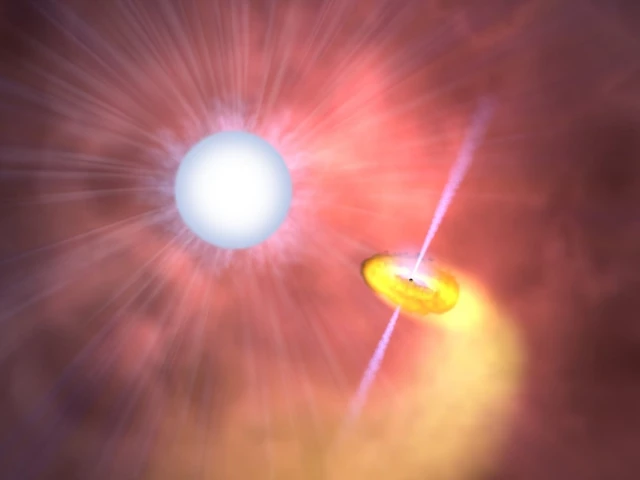
Have you ever gazed up at the stars and wondered what lies beyond our planet? Recently, scientists using China’s Large High Altitude Air Shower Observatory (LHAASO) have unveiled mind-blowing findings about a stellar duo in the constellation Cygnus — specifically, Cygnus X-3. Designed as a high-mass X-ray binary system, Cygnus X-3 consists of a compact object, likely a black hole or neutron star, in tandem with a massive Wolf-Rayet star. This fascinating system has just been identified as the most powerful particle accelerator known to humankind.
So, what makes Cygnus X-3 so special? Traditionally, scientists believed that charged particles in the Milky Way could achieve energies up to about 1 peta-electron volt (PeV). However, through meticulous analysis of ultra-high-energy gamma rays, the LHAASO team has confirmed that Cygnus X-3 can ramp up cosmic-ray particles to astonishing energies of at least 30 PeV! That’s a game-changer for astrophysics.
Understanding cosmic rays is crucial because they offer insights into some of the universe’s most extreme physical processes. As this compact object voraciously consumes material from its stellar companion, it accelerates these particles to unprecedented energies. The LHAASO research team, led by principal investigator Cao Zhen, highlighted a fascinating 4.8-hour periodicity in the gamma-ray signal, hinting at a rhythm in the celestial orchestra. This discovery narrows the particle acceleration zone to about three times the solar radius, providing a clearer picture of what’s happening in this high-energy environment.
Situated at a staggering 4,410 meters above sea level in southwestern China’s Sichuan Province, LHAASO spans 1.36 square kilometers and stands as a beacon for cosmic ray and gamma-ray observation. The findings from this research have been published in the National Science Review, offering rich groundwork for future inquiries into the universe’s most enigmatic phenomena.
As we peel back the layers of the cosmos, discoveries like those around Cygnus X-3 remind us that there’s always something new and thrilling to learn. Whether you’re a curious reader or a budding astrophysicist, staying connected with the latest in space science can be an exciting journey. At Pro21st, we’re passionate about exploring the universe and sharing these incredible discoveries with you. Let’s keep gazing at the stars — who knows what wonders await us next?