
Celebrating a Groundbreaking Achievement: 2026 Nobel Prize in Chemistry
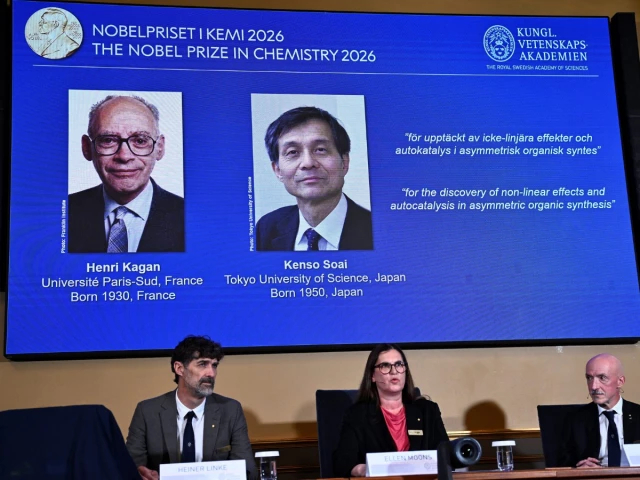
In a thrilling revelation this week, scientists Henri Kagan and Kenso Soai were awarded the prestigious 2026 Nobel Prize in Chemistry. Their remarkable work unlocks new pathways for pharmaceutical manufacturing by unraveling the mystery of how to create a single molecular mirror image. This debate has intrigued chemists for over a century and is crucial to understanding how many life-essential molecules function.
Professor Kenso Soai expressed his elation during a Nobel Prize press conference, saying, "This is the most exciting day in my life; I am very glad to share this prize with Professor Henri Kagan." The excitement among the scientific community is palpable, especially since this discovery has profound implications for drug development.
So, what exactly did they discover? Their research focuses on a phenomenon called "homochirality," where living organisms tend to utilize only one mirror image of a molecule—think left and right hands. This preference is vital, especially in drugs where one variant may deliver therapeutic effects, while the other may trigger harmful side effects. The Nobel Committee noted that Kagan and Soai’s findings will help chemists design reactions that favor the desired mirror image.
Heiner Linke, chair of the Nobel Committee for Chemistry, shared, "This year’s prize is about foundational chemistry." The implications for the pharmaceutical industry are vast, providing new tools for designing safer and more effective drugs.
The Nobel Prize, established by Alfred Nobel’s will in 1901, acknowledges revolutionary achievements across multiple fields, including medicine and physics. While the chemistry awards might not always steal the spotlight, they’ve recognized groundbreaking work, such as nuclear fission and genetic sequencing.
The ceremony will take place on December 10th in Stockholm, where the laureates will receive their medals from King Carl XVI Gustaf. Along with the honor, they will also share a prize of 12 million Swedish crowns (around $1.2 million).
As we celebrate this groundbreaking achievement, it’s a good moment to reflect on how scientific advancements shape our everyday lives and industries. If you’re inspired by such transformative discoveries, consider connecting with Pro21st, where we explore innovative ideas at the intersection of science and industry. Stay curious, and keep looking for ways science impacts you!