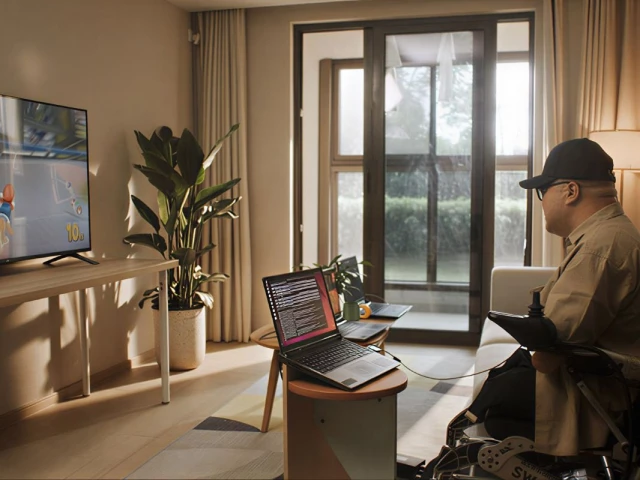

Breaking Barriers: How Brain-Computer Interfaces are Transforming Lives
Imagine waking up one day, only to find that a spinal-cord injury has left you paralyzed. This was the reality for a patient who faced such a daunting situation in 2022. Yet, just a few years later, a groundbreaking clinical trial involving brain-computer interfaces (BCI) allowed him to steer a smart wheelchair and even direct a robotic dog—all through the power of thought.
Conducted by the Chinese Academy of Sciences, the trial showcased a significant leap in the world of rehabilitation technology. The patient, now quadriplegic, received an advanced brain-computer interface in June 2025. Within weeks, he was capable of controlling a computer cursor and a tablet. This innovation isn’t just about playing video games; it’s about regaining independence.
BCIs create a direct line of communication between the brain and external devices. While laboratory demonstrations of "mind typing" and robotic-arm control have been impressive, the real challenge lies in making these systems reliable enough to integrate seamlessly into everyday life.
The BCI system employed during the trial was highly sophisticated, using a wireless invasive setup to allow the patient to maneuver a smart wheelchair and command a robotic dog for fetching items. This leap forward not only signals the potential for enhanced mobility but also breaks down the barriers that have traditionally limited paralyzed individuals.
What’s even more remarkable is how the research team combined distinct decoding strategies. By filtering out the noise in neural signals, they improved command reliability by over 15%. They’ve also managed to reduce the time it takes for neural input to translate into action to under 100 milliseconds—faster than the body’s natural response time. This fluidity means the man is not merely reacting; he is now engaging with his environment in a manner that’s efficient and relatable.
This shift from basic interaction to real-life applications signifies a broader commitment in China to advance the technology for practical use. Imagine being able to traverse the neighborhood or retrieve a food delivery all by mere thought. The possibilities are endless and immensely hopeful for those who find themselves in similar situations.
As we step into an era where technology meets neuroscience, it’s clear that innovations like these can dramatically enhance quality of life. If you’re intrigued by developments in brain-computer interfaces and their applications, consider exploring resources at Pro21st to learn more and stay updated on this fascinating integration of technology and human potential.