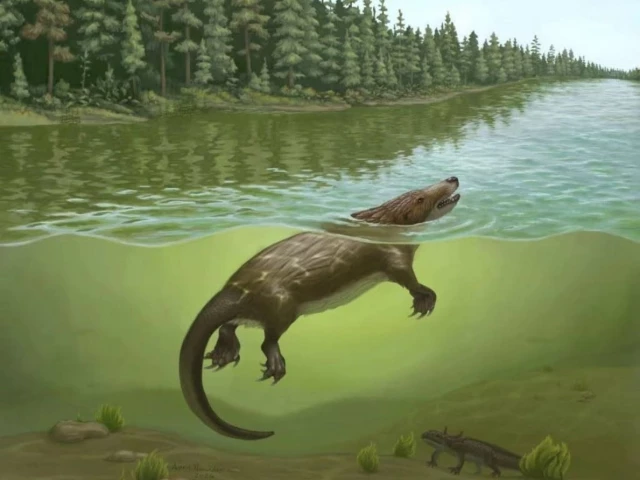

Unveiling the Secrets of the Past: Meet Megacauda sungei
Imagine wandering through a lush prehistoric landscape about 160 million years ago. Among the towering trees and roaming dinosaurs, a unique creature—Megacauda sungei—thrived. Recently discovered by a team of international researchers led by Chinese scientists, this docodont mammaliaform is breaking new ground in our understanding of Jurassic life.
Why is Megacauda sungei so special? For starters, it’s the largest known member of its group, reaching about 52 centimeters in length and weighing around 2 kilograms. Found in Ningcheng, Inner Mongolia, its remarkably preserved fossil showcases a robust trunk, clearly defined skull, and most notably, an impressively long, coiled tail. This tail suggests that it might have been adept at swimming, much like modern-day platypuses, adding an intriguing twist to our understanding of ancient mammals.
Researchers believe Megacauda sungei wasn’t just an observer of its environment; it likely hunted small animals, showcasing behaviors that hint at evolutionary advancements. The well-preserved pelvic bones and limbs reveal adaptations that could support a swimming lifestyle. But the surprises don’t end there! Insights into its throat structure indicate that behaviors like suckling and lapping might have existed long before the emergence of today’s mammal groups.
Li Yikun, an associate professor at Shenyang Normal University, put it succinctly: “Mammaliaforms from the Mesozoic are often imagined as tiny creatures under dinosaur feet, but Megacauda sungei clearly raises the size limit of this group.” This means that the mammal lineage was much more diverse and capable than previously thought, contradicting the perception of them being merely insignificant players in the shadow of dinosaurs.
These findings, which were published in Nature, offer a fascinating glimpse into the complexities of life during the Jurassic era. The discovery not only enriches our understanding of mammalian evolution but also sparks curiosity about the adaptability and variety of prehistoric creatures.
If you’re intrigued by ancient life and its evolution, consider diving deeper into similar topics. You can stay connected with others who share your passion for science and discovery at Pro21st, a platform dedicated to enlightening conversations and connections. Who knows what other amazing discoveries await in the depths of our planet’s history?