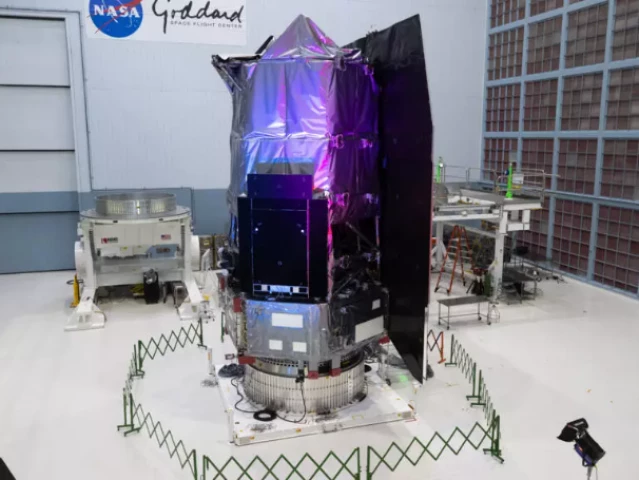

Unveiling the Roman Space Telescope: A New Era in Astronomy
NASA recently introduced the highly anticipated Roman Space Telescope, set to launch aboard a SpaceX rocket. This groundbreaking telescope promises to revolutionize our understanding of the universe, aiming to discover tens of thousands of exoplanets and delve into the mysteries of dark matter and dark energy.
Imagine an instrument that has a field of view at least 100 times larger than the legendary Hubble Space Telescope! With a 12-meter-wide design and massive solar panels, the Roman telescope will be stationed 1.5 million kilometers from Earth, far enough to capture stunning cosmic visuals. According to NASA administrator Jared Isaacman, “Roman will give the Earth a new atlas of the universe.”
The sheer volume of data is staggering—Roman is expected to send down about 11 terabytes of information daily. To put that in perspective, in just its first year, this telescope will transmit more data than Hubble has collected throughout its entire mission! This wealth of information is crucial, as it will allow scientists to create a comprehensive census of the objects making up our universe.
In addition to searching for new planets, Roman will also shine a light on the enigmatic concepts of dark matter and dark energy. Thought to comprise about 95% of our universe, these phenomena are still largely misunderstood. Dark matter acts as the scaffolding holding galaxies together, while dark energy is believed to be the force driving the universe’s expansion. By employing infrared technology, Roman will be able to look back billions of years to better understand these cosmic mysteries.
What’s even more exciting? Roman won’t be working alone. It will complement other missions, like the James Webb Space Telescope and Europe’s Euclid observatory. Together, they will provide a clearer picture of how dark matter shapes cosmic structures and how galaxies are moving through space.
Julie McEnery, a leading astrophysicist on the Roman project, highlights the potential for groundbreaking discoveries, stating, “If Roman wins a Nobel Prize at some point, it’s probably for something we haven’t even thought about or questioned yet.” The possibilities are as vast as the universe itself.
As we prepare for this launch set for September at the earliest, the excitement is palpable. The Roman Space Telescope might just redefine what we know about our cosmic neighborhood and beyond.
For those looking to explore more about such thrilling developments in space and science, consider connecting with Pro21st. Engaging with community discussions and insights can deepen your appreciation for these astronomical advancements.