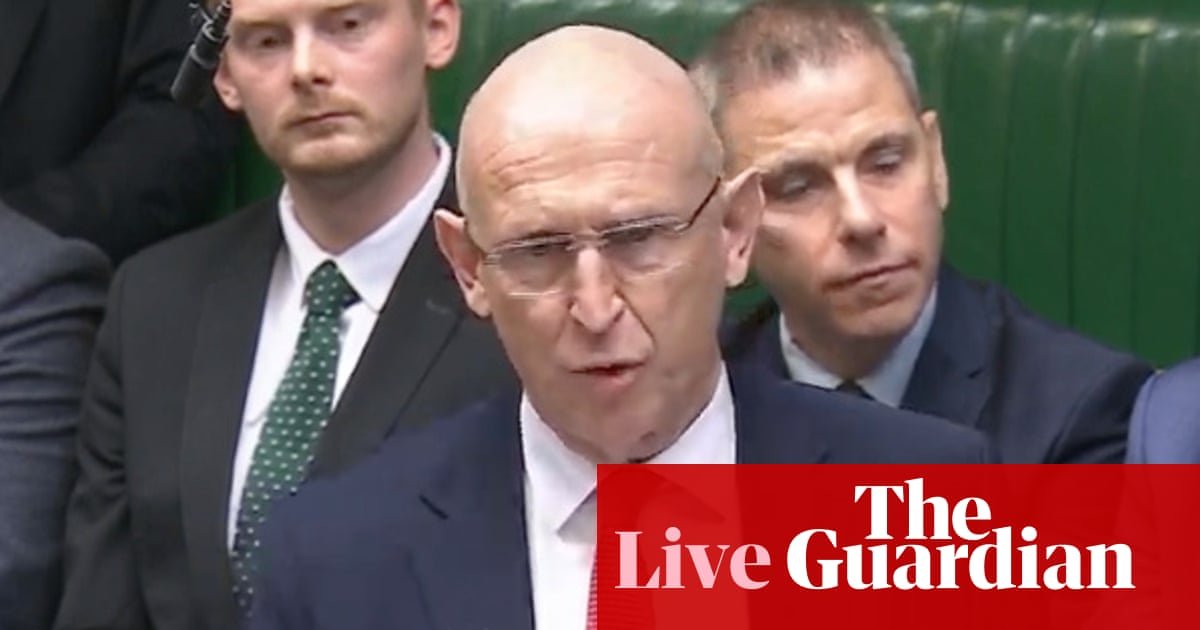

Healey says DIP ‘well short of what’s required’, and UK’s enemies ‘don’t follow timetable set by Treasury’
Healey said Keir Starmer knows what is needed.
The prime minister knows what the country needs for defence. He spelled out the threat this month when he said it is our intelligence assessment and the assessment of other countries in NATO that there could be an attack by Russia on Nato as soon as 2030.
So Britain must set the head mark of spending 3% on defence in 2030, and a clear path to 3.5% in 2035.
The commitment all Nato nations have made to each other and to their people … commands wide cross-party support.
Our predecessors in this house experienced what happens when deterrence fails. Our predecessors in this House entrusted us with institutions like Nato that they created to keep us safe.
We don’t choose the circumstances in which we serve or the responsibilities that fall upon us, either in this house or in government.
And it’s the duty of our political generation now to ready Britain for the uncertainties of the years to come. The decisions that we make in the months ahead will be judged by those who follow us.
At this dangerous time. I see the current defence investment plans falling well short of what is required, a rise of 0.08% from next year to 2030.
No date for reaching 3%, no path to 3.5% by 2030.
Well over half of Nato members will be spending 3% or more. And when allies are looking for British leadership, we must not fall behind.
When NATO needs European nations to step up, we must not fall short.
Our adversaries don’t follow timetable set by the Treasury.
Key events
-
Rayner dismisses claim better pay and conditions for young people contributes to youth unemployment
-
No 10 says Dartmoor ponies won’t be culled – but Tories say PM can’t be trusted, and launch petiton to save them anyway
-
Bridget Phillipson says Badenoch’s ‘Gestapo’ jibe about her shows she’s ‘not fit to be PM’
-
Starmer and von der Leyen agree next UK-EU summit to take place on 22 July
-
Starmer denies being snubbed by Trump at G7 summit
-
John Healey and Al Carns’ resignation speeches – snap verdict
-
Carns suggests Northern Ireland Troubles bill will help republicans achieve what IRA wanted
-
Carns says MoD spending ‘too much time preparing for last year’s war, not tomorrow’s’
-
Al Carns suggests Labour has let down its core voters in his resignation speech to MPs
-
Healey says UK needs ‘bigger view of national security’
-
Healey says DIP ‘well short of what’s required’, and UK’s enemies ‘don’t follow timetable set by Treasury’
-
Healey says defence needs ‘harder choices’, not just ‘incremental change’
-
Healey says he thinks his resignation will ‘in time’ help ensure defence gets more funding
-
John Healey delivers statement on his resignation to MPs
-
710 migrants arrived in small boats on Monday, figures show – but overall arrivals down 40% on same point in 2025
-
UK will have to ‘dial back’ military plans without more funding, says chief of defence staff
-
Having Burnham, not Starmer, as leader would give Labour 4-point boost against Reform UK, poll suggests
-
Greens condemn Streeting’s call for Rosebank and Jackdaw drilling as ‘environmentally reckless’
-
Burnham’s approval ratings down since he launched byelection campaign, but still far better than his rivals’, polls show
-
Starmer should set out timetable for his departure if Burnham wins byelection, Streeting says
-
Starmer says Dan Jarvis, new defence secretary, being consulted on DIP ahead of final version being published
-
Starmer says arson attacks on property linked to him should be seen in ‘broader context’ of Russian threat
-
Streeting warns against ‘expensive’ pledges in leadership contest, and defends bond markets, in dig at Burnham
-
Streeting says UK capitalism ‘suffers from lack of competition’ as he makes case for ‘progressive capitalism’
-
Thames Water nationalisation moves closer as government ‘objects to rescue deal’
-
Elon Musk claims social media ban for under-16s shows UK ‘police state’
-
UK ministers lobby Trump to avert backlash against social media ban
-
Starmer vows new sanctions on Russia and nuclear energy support for Ukraine
-
Anti-Burnham fake news on Makerfield Facebook accounts has surged, report finds
Rayner dismisses claim better pay and conditions for young people contributes to youth unemployment
Angela Rayner, the former deputy PM, has dismissed claims that better pay and conditions for young people is bad for their employment prospects.
Before she resigned last year, Rayner was a key figure driving the employment rights bill through parliament. It was described as the biggest boost to workers’ rights for a generation. The government has also overseen a significant increase in the minimum wage for young workers, and has pledged to ensure all over-18s over time get the full adult rate (now paid to over-21s).
Employers have opposed both these developments, claiming they make firms less likely to hire new workers. And last month, when he publised his much-admired report on young people not in education, employment or training (Neets), Alan Milburn, the former Labour cabinet minister, suggested these Labour policies were contributing to the problem.
Addressing the Unison conference this afternoon, Rayner insisted that better wages and conditions for young people were not to blame.
She said:
Let me start with the argument that better wages and conditions for young people are why there are not enough jobs for them, and that we must retreat.
Today, I want to take that argument on. Head on.
I agree that the tide of young people not in employment, education or training is a genuine problem.
But as Alan Milburn found, it is long-term and structural, and has been consistently higher than other countries since long before Labour took office, let alone improved pay for young people.
It’s why we didn’t bring in our changes to the minimum wage overnight but let the Low Pay Commission do its job.
And I’m passionate about getting young people, including those with disabilities or health challenges, into good jobs.
But abandoning our ambitions and making those jobs worse surely cannot be the way to get young people into them.
And this is the wider point. Better quality jobs – with a stronger voice for people at work – is the solution, not the problem.
It is how we build the higher productivity, higher pay economy that we need.
No 10 says Dartmoor ponies won’t be culled – but Tories say PM can’t be trusted, and launch petiton to save them anyway
This morning the Times ran a story about their being too many semi-wild ponies on Dartmoor and suggesting some of them could be culled. Anyone familiar with British voters, British newspapers and British polticians could tell what was going to happen next.
There has been uproar online. And the denials have come thick and fast.
A No 10 spokersperson said:
So, let me be very clear on this: this government will not allow a cull of Dartmoor ponies and we don’t manage feral pony populations by culling in this country.
Natural England has not recommended a cull of Dartmoor ponies and it does not have the power to order a cull and has not advised one.
And, more broadly, Dartmoor ponies are part of the cultural landscape of Dartmoor and play a vital role in the health of its moorland habitats.
[The ponies are] safe under this government.
A spokesperson for the Department for Environment, Food and Rural Affairs said:
Dartmoor ponies are an important part of Dartmoor’s heritage and also key to supporting the habitats of Dartmoor.
Natural England are not recommending a cull and this government wouldn’t support one.
But that has not stopped the Conservative party launching a petition. The Tories say:
Keir Starmer might have said he won’t allow the ponies to be shot. But the prime minister has a history of saying things and not acting on them, and u-turning when the going gets tough.
So the Conservatives are urging Labour to intervene, overrule Natural England and ensure Dartmoor’s ponies are protected, and calling on the public to sign our petition at www.savetheponies.com
Like most political petitions, this one seems to be more about data harvesting (it asks for an email address, and details of how you voted in 2024, and how you might vote in the next local elections) than about influencing government decision making.
Helena Horton has a sensible account of the problem here.
Bridget Phillipson says Badenoch’s ‘Gestapo’ jibe about her shows she’s ‘not fit to be PM’
Bridget Phillipson, the education secretary, has finally got round to reading Tim Shipman’s account in the Spectator of the live interview he did with Kemi Badenoch at an event last week. She is not happy.
In a passage praising Badenoch’s willingness to be direct, Shipman says:
Ed Miliband’s insistence that these assets remain in the ground is ‘very much like what the Nigerian military dictatorships were doing in the 1980s and 1990s’. Bridget Phillipson, by raiding VAT on private school fees ‘has acted like a Gestapo officer’. Of Starmer she says: ‘I’ve grown to feel sorry for him, but I have also grown to dislike the way he does not take any responsibility.’
This afternoon Phillipson has posted a message on social media saying:
The Gestapo marched hundreds of thousands of innocent people to their deaths.
I’ve ended private schools’ tax breaks to invest in state schools.
No responsible leader makes vile comparisons like this. Kemi Badenoch is not fit to be Prime Minister.
Starmer and von der Leyen agree next UK-EU summit to take place on 22 July
Keir Starmer and Ursula von der Leyen, the European Commission’s president, have agreed that the next UK-EU summit will take place on Wednesday 22 July.
After they met at the G7 summit, Starmer said:
My Labour government is delivering on our promise to reset our relationship and put Britain at the heart of Europe.
Together we will tackle the cost of living, boost jobs and create opportunities for young people.
Starmer denies being snubbed by Trump at G7 summit
Keir Starmer has denied being snubbed by Donald Trump at the G7 in France after the two did not have a bilateral meeting at the summit. Alexandra Topping has the story.
John Healey and Al Carns’ resignation speeches – snap verdict
It would be easy to assume that, because John Healey and Al Carns both served with each other as defence ministers, and because they resigned on the same day for the same reason, they were engaged in some sort of common endeavour. Anyone watching them give consecutive “personal statements” in the Commons about why they resigned would realise that is completely wrong.
Although they were sitting not far from each other in the chamber, there was little interaction between them and their relationship seemed frosty. By all accounts, it is.
They both criticised the defence investment plan, but Carns suggested the main problem with the Dip was not how much was being spent, but what it was being spent on. (See 2.33pm.) This was an implicit criticism of the plan Healey had spent a year developing. He was also fiercely critical of the Northern Ireland Troubles bill – not Healey’s legislation, but legislation that Healey has been willing to support.
Healey started his own speech with a passage about his lifelong commitment to Labour. This may not have been intended as a jibe against Carns, who has very little Labour history because he spent his career in the armed forces where politics is shunned. But, even if that was not the purpose, it served to remind Labour MPs which of the two ex-ministers has deepest roots in the party. Carns does not have a privileged background, being brought up by a single mother in Aberdeen, but his evocation of the Labour party “chiselled out of the mines of the north-east” sounded a bit hackneyed, and it bore little relationship to Labour as it is now.
Quentin Letts, the Mail sketchwriter, says, watching from the gallery, it was clear who went down best with Labour MPs.
Healey’s the more powerful (and short) of the two resignation statements. Carns speaks as if addressing a parade ground. Plenty of Lab MPs nodded to both speeches but some backbenchers looked mutinous during Carns.
Carns suggests Northern Ireland Troubles bill will help republicans achieve what IRA wanted
In his speech Carns also said he thought the defence investment plans was not sufficiently funded.
But he then went on to spent more time talking about another reason for his resignation – his opposition to the Northern Ireland Troubles bill. On this, he went even further than he did in his resignation letter last week – because he suggested the legislation would help republicans achieve what the IRA was fighting for.
He said:
The IRA failed to achieve its political ends through the use of terrorist tactics. We must be exceptionally careful that we do not help them achieve those ends through other means.
The constant, never-ending legal wranglings that undermine the contract between the nation and those that serve is neither a good use of taxpayer money nor an effective execution of strategy.
Inquests, inquiries and an independent commission create a hierarchy of truth. It will cost us hundreds of millions for 15 years, painting the state as an aggressor, supporting our adversaries’ political objections and causing untold anguish for those that only ever deployed to protect us.
We have neither the political capital nor the resources to spare for this unjust journey.
Carns says MoD spending ‘too much time preparing for last year’s war, not tomorrow’s’
Carns cited the defence investment plan (Dip) as the first reason for his resignation.
But, unlike Healey, who in his resignation letter last week and in his speech to MPs cited funding as the main problem with the Dip, Carns suggested the main problem was that it was focused on the wrong items.
This was an implicit criticism of Healey, who (unlike Carns) had been working on the Dip for months.
Explaining why he quit, Carns said:
Firstly, because I no longer believe the defence investment plan was preparing for the wars we are most likely to fight.
The character of warfare is changing at an exceptional speed.
In Ukraine a navy without a ship has destroyed a navy. A drone costing thousands candestroy a tank costing millions. A drone can now strike 2000km into Russia at a fraction of the cost of a fighter jet.
It is not either/or. It’s an equitable mix of high-end sophistication coupled with low-end mass. That’s the balance we must seek.
But from my view, the defence investment plan did not strike that balance for various reasons.
Carns went on to give an example.
I want to give just a small example to bring that home because it can be often lost.
In a town in Ukraine similar to the same size as Hereford in one day there were 12,000 drones in the air. Just comprehend that – 12,000 drones in the air and 90% of all casualties are from drones.
Not the rifle, not the grenade, not the tank, not the artillery, but from drones.
What will it take to realise these figures are not fiction. They’re not an embellishment of the truth, but a hard fact born the blood and the steel of a hot war.
That is the mass of modern war – millions of drones against high-end, sophisticated systems that deliver late with huge levels of inflation and, importantly, cannot be reproduced at the pace required to sustain a conflict against a major adversary.
Carns said that Britain should not have to relearn lessons it had learned in the past about investing money in the wrong defence equipment. He went on:
We are no longer packaging up our military to deploy to a foreign field, but being ready to fight from here, right from the home base, for democracy, for the right to self-determination and for European security. The reality is we are spending too much time preparing for last year’s war, not tomorrow’s.
And I urge the house to push for transformation, push hard and push for delivery this side of 2030.
Al Carns suggests Labour has let down its core voters in his resignation speech to MPs
Healey was followed in the Commons by Al Carns, who also resigned as armed forces minister on Thursday last week, about eight hours after Healey. Like Healey, Carns also said he was going because he thought the defence investment plan (Dip) was under-funded. But there has been speculation that he only decided to quit after it became clear that he was not being offered Healey’s job.
Carns told MPs that resigning as a minister was “an exceptionally difficult decision”.
He said that, when he accepted ministerial office, he did so “with a simple purpose to serve those that serve us”. He went on:
There comes a point when honesty requires action. And for me, that point came last week.
As honourable members know, I came into politics for one reason. That was to enact change.
But to be able to work out where you’re going, we must realise where we have come from. The Labour party I joined is one that was chiselled out of the mines of the north-east. It was hammered out of the shipyards of Govan, Liverpool and Belfast. And it was forged in the factories of the industrial revolution.
Calloused hands, sore backs, people who did a hard day’s graft and asked for one thing in return – a government that has their back.
That’s the tradition I serve in this house, and it’s a tradition that shaped that decision I took last week.
And I resigned for several reasons.
Healey says UK needs ‘bigger view of national security’
Healey said he was grateful to cabinet colleagues who agreed to cuts to fund higher defence spending.
He went on:
There are credible ways of meeting the mid-term funding challenges, working multinationally and as other nations in Europe are doing.
They could allow us to protect the ability to deliver our Labour missions across government.
Healey also calls for a different approach to defence.
We need a bigger view of national security. It’s not just the job for defence or the agencies. Every department has a part to play in national security and national resilience.
From energy to transport to health, security must run through the government like letters through a stick of rock.
And security must be felt in the communities right across Britain, reversing long term decline and bringing new jobs and new hope.
At the start of his speech Healey said that, now he was no longer defence secretary, he was glad he did not have to sleep with three phones by his bed. He ended with a joke about his personal love for HP sauce.
For now, Jackie [Healey’s wife] is just grateful I no longer carry three phones in my bag, although I do still have my bottle of HP sauce.
Healey says DIP ‘well short of what’s required’, and UK’s enemies ‘don’t follow timetable set by Treasury’
Healey said Keir Starmer knows what is needed.
The prime minister knows what the country needs for defence. He spelled out the threat this month when he said it is our intelligence assessment and the assessment of other countries in NATO that there could be an attack by Russia on Nato as soon as 2030.
So Britain must set the head mark of spending 3% on defence in 2030, and a clear path to 3.5% in 2035.
The commitment all Nato nations have made to each other and to their people … commands wide cross-party support.
Our predecessors in this house experienced what happens when deterrence fails. Our predecessors in this House entrusted us with institutions like Nato that they created to keep us safe.
We don’t choose the circumstances in which we serve or the responsibilities that fall upon us, either in this house or in government.
And it’s the duty of our political generation now to ready Britain for the uncertainties of the years to come. The decisions that we make in the months ahead will be judged by those who follow us.
At this dangerous time. I see the current defence investment plans falling well short of what is required, a rise of 0.08% from next year to 2030.
No date for reaching 3%, no path to 3.5% by 2030.
Well over half of Nato members will be spending 3% or more. And when allies are looking for British leadership, we must not fall behind.
When NATO needs European nations to step up, we must not fall short.
Our adversaries don’t follow timetable set by the Treasury.