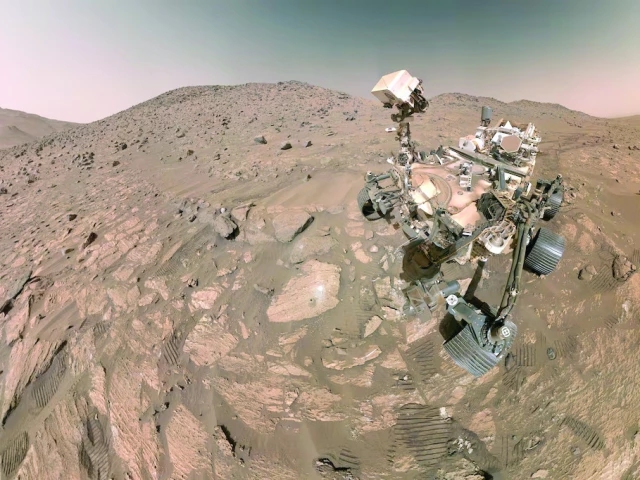

Unveiling Mars’ Ancient Water History: What Perseverance Discovered
NASA’s Perseverance rover has been busy making remarkable discoveries on Mars, and its latest findings are particularly exciting. By using ground-penetrating radar, Perseverance has detected buried evidence of a river delta that dates back between 3.7 to 4.2 billion years. That’s not just ancient; it’s a glimpse into a time when water flowed freely on the Martian surface!
As the rover navigated through Jezero Crater—an area that scientists believe once housed a large lake—researchers identified geological formations up to 115 feet below the surface. The radar map revealed layers of sediments and signs of an environment that likely harbored liquid water, similar to river deltas here on Earth. This could be crucial in understanding Mars’ wet past and its potential to support life.
But why is this finding so important? Well, the presence of water is a key indicator in the search for past life on Mars. The rover’s RIMFAX instrument, which emits radar pulses that bounce back to create a 3D map of the terrain, gave us the deepest insights yet—showing us that Mars wasn’t always the cold, desolate planet we see today.
Emphasizing the significance of this discovery, UCLA planetary scientist Emily Cardarelli noted, "We believe that Jezero Crater hosted an ancient water-rich environment capable of biosignature preservation." In simpler terms, this means that there could be evidence of life waiting to be discovered.
On Earth, river deltas are bustling ecosystems that provide the right conditions for life to bloom. Imagine the possibilities if Mars had similar environments! In previous missions, Perseverance has already collected rock samples containing potential biosignatures—clues hinting at ancient microbial life, though scientists caution that some minerals can form through non-biological processes.
Since arriving on Mars in 2021, Perseverance has traversed 3.8 miles of crater terrain, piecing together the planet’s history. As planetary scientist David Paige put it, this data allows researchers to solve some of the puzzles surrounding the origins of these deposits. Each finding leads us closer to understanding the complex history of our neighboring planet.
Mars exploration has truly become a collaborative international effort. Last year, China’s Zhurong rover also made waves by detecting signs of what might have been sandy beaches from an ancient ocean. These types of findings validate the ongoing investigations into Martian geology and water presence, continually painting the picture of a planet that was once very different from its current state.
As we reflect on these groundbreaking discoveries, it’s clear that every piece of evidence brings us one step closer to understanding the possibility of life beyond Earth. If you’re as intrigued by Mars and space exploration as we are, consider engaging further with communities who share this passion, like Pro21st. Together, we can dive deeper into the mysteries of our universe!